
The PlayStation Was Born From Revenge: How Nintendo Betrayed Sony
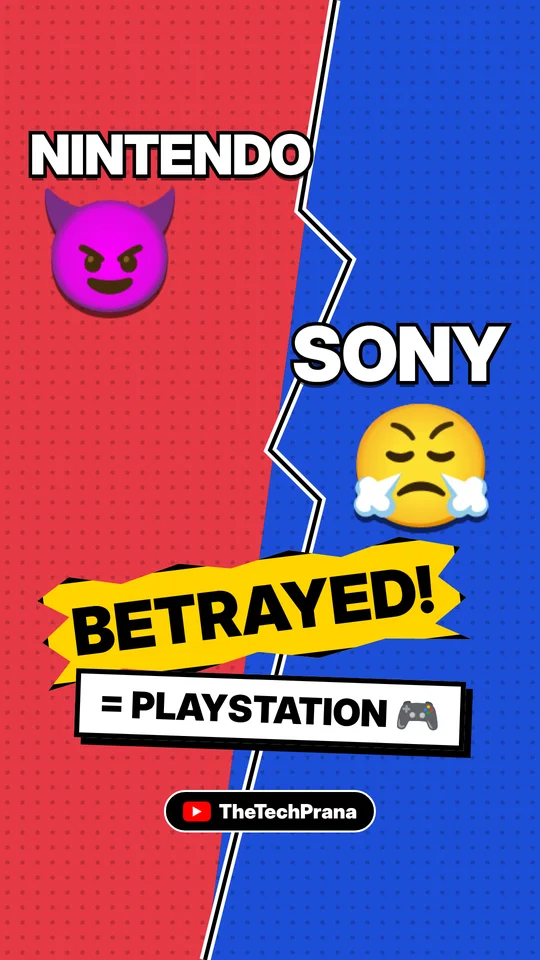
In 1991, Sony announced a CD add-on for the Super Nintendo – and the next day Nintendo picked Philips instead. Sony's answer was the PlayStation.
 Abheek··5 min read
Watch the Short
The 60-second version is on YouTube. This article is the full story.
New Shorts every week on tech trivia, AI and gadgets.
Subscribe to TheTechPranaKey takeaways
- In 1988, Nintendo signed Sony to build a CD-ROM add-on for the Super Nintendo.
- In June 1991, Sony announced it at CES – and the very next day Nintendo revealed a new partner, Philips.
- Sony turned the project into its own console. The PlayStation launched in Japan in December 1994 and sold over 100 million units.
Some of the biggest products in tech history came from careful planning. The PlayStation came from a public snub. If Nintendo had kept its promise to Sony in 1991, there might never have been a PlayStation at all.
The Short above tells it like a comic book. Here’s the full story.
1988: an unlikely partnership
In the late 1980s, Nintendo ruled video games. Sony was an electronics giant – Walkmans, TVs and, importantly, CD technology, which it had co-developed with Philips.
CDs could hold far more data than game cartridges. So in 1988, Nintendo signed a contract with Sony to build a CD-ROM add-on for the Super Nintendo (SNES), which was then in development.
Sony’s project lead was an engineer named Ken Kutaragi. He had already designed the sound chip inside the Super Nintendo, and he believed games would become a major business for Sony – a view not everyone at the company shared.
June 1991: the betrayal
In June 1991, at the Consumer Electronics Show (CES) in Chicago, Sony proudly announced its CD-based system with Nintendo. It was known as the “Play Station”.
The very next day, at the same show, Nintendo stood up and announced a new partner for its CD add-on: Philips.
Sony found out in public, in front of the industry. The deal it had just announced was, in effect, dead.
Why did Nintendo switch?
Accounts differ, but the widely reported reason is control. The original contract is said to have given Sony significant rights over games released on the CD format – and Nintendo was famous for keeping tight control of its platform and its licensing money. Partnering with Philips offered Nintendo better terms.
(For the record, the Nintendo–Philips CD add-on never came out either. Philips was later allowed to use some Nintendo characters on its own CD-i machine, which produced some infamously bad Zelda and Mario games.)
“We will never withdraw”
Inside Sony, some executives wanted to quit video games altogether. But Sony’s president, Norio Ohga, reportedly told the team: “We will never withdraw from this business. Keep going.”
Kutaragi was given the go-ahead to turn the project into something new: Sony’s own, standalone console, built for CDs and 3D graphics from the ground up.
December 1994: the PlayStation arrives
The PlayStation launched in Japan in December 1994, followed by North America and Europe in 1995.
It was a massive success:
- CDs made games cheaper to produce and allowed music, video and huge worlds.
- It attracted big third-party publishers and helped make 3D gaming mainstream.
- Over its lifetime, it sold more than 100 million units – the first home console to pass that milestone.
Kutaragi became known as the “father of the PlayStation”, and Sony went on to become one of the biggest names in gaming, competing directly with the company that had snubbed it.
The twist: a $360,000 prototype
Before the split, Sony and Nintendo had built around 200 prototypes of the joint “Nintendo PlayStation” – a Super Nintendo with a CD drive, bearing both companies’ names.
Almost all of them disappeared. But one surfaced years later, and in March 2020 it sold at auction through Heritage Auctions for $360,000. Guinness World Records lists it as the most expensive video game console sold at an online auction.
The lesson
Nintendo’s 1991 move may have looked smart at the time. Instead, it created its biggest rival.
Quick recap
- 1988: Nintendo signs Sony to build a Super Nintendo CD-ROM add-on
- June 1991: Sony announces it at CES; the next day Nintendo reveals Philips
- Ohga: “We will never withdraw from this business” (reportedly)
- Dec 1994: PlayStation launches in Japan; 100M+ sold
- 2020: a surviving “Nintendo PlayStation” prototype sells for $360,000
Your turn: is this the best revenge story in tech history? Tell us in the YouTube comments.