
AI vs Agentic AI vs AGI: The Difference, Explained Simply
AI answers, agents act, AGI is the goal. The difference between AI, agentic AI and AGI explained with one simple example: planning a trip to Goa.
 Abheek··5 min read
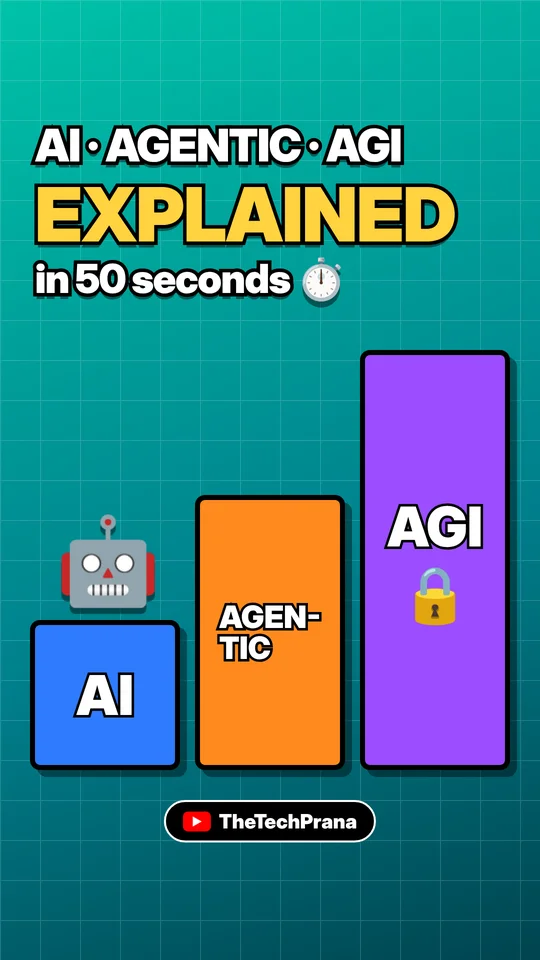
Watch the Short
The 60-second version is on YouTube. This article is the full story.
New Shorts every week on tech trivia, AI and gadgets.
Subscribe to TheTechPranaKey takeaways
- AI (as most of us use it today) answers when you ask: you request a trip plan, it writes one.
- Agentic AI takes a goal and carries out the steps itself, using tools, with limited supervision: comparing flights, booking the hotel, updating your calendar.
- AGI – a system as capable as people at almost any thinking task – is still hypothetical, and experts don't agree on exactly what it means.
AI, agentic AI, AGI. You hear all three every day, often as if they mean the same thing. They don’t – and the difference is easy once you see it with one example.
The Short above does it in 50 seconds. Here’s the slightly longer version, using one running example: planning a 3-day trip to Goa.
Level 1: AI – you ask, it answers
This is the AI most people use today: a chatbot or assistant that responds to a request.
You type: “Plan me 3 days in Goa.” It writes a neat day-by-day plan – beaches, food, a fort or two.
What it doesn’t do is act on that plan. You still compare flights, book the hotel and put it all in your calendar yourself.
Technically, almost all AI in use today is what researchers call “narrow” AI: very capable inside specific tasks, but not a general mind. IBM describes nearly all current AI this way.
Level 2: Agentic AI – you give a goal, it takes the steps
Agentic AI (or “AI agents”) goes one step further. Instead of a question, you give it a goal – and it works out the steps and carries them out, using tools, with limited supervision.
Same trip, agent style:
- Compares flights for your dates
- Books the hotel
- Adds the trip to your calendar
IBM defines agentic AI as a system that can accomplish a specific goal with limited supervision. It usually builds on the same generative AI as Level 1, but adds the ability to plan and to use external tools – websites, apps, payment systems.
(The Goa steps are an illustration of how agents work, not a review of any specific product.)
This is already real
It isn’t science fiction. On 13 November 2026, OpenAI launched ChatGPT Wallet, which lets its agents (called “dots”) help you choose what to buy and then complete the purchase for you.
It’s limited for now: the first rollout is for a limited number of U.S. ChatGPT Pro subscribers aged 18+, with a U.S.-issued card. And you stay in control – you review the items, the total and the card, and approve each purchase before checkout.
That last part matters: today’s agents still work under human approval, especially where money is involved.
Level 3: AGI – as good as people at almost anything
AGI stands for artificial general intelligence. The rough idea: a system that’s as capable as people at almost any thinking task – not just one domain.
In our example, an AGI could plan the Goa trip… and then do your job too.
There’s no single agreed definition. One well-known version comes from OpenAI’s Charter, which describes AGI as “highly autonomous systems that outperform humans at most economically valuable work.”
The twist: AGI is still hypothetical
Here’s the part the hype often skips:
- AGI does not exist yet. IBM describes it as a hypothetical stage of AI development.
- Experts don’t agree on what it means, or on how you’d even measure it. Science News has reported that there’s limited agreement on the definition and no clear test.
That’s why you’ll see very different claims. When GPT-6 Astra launched in September 2026, OpenAI’s Greg Brockman described it as the start of AGI (our GPT-6 explainer has the background). Many researchers don’t consider today’s models AGI. Both views exist because there’s no shared finish line.
The three levels side by side
| AI | Agentic AI | AGI | |
|---|---|---|---|
| You give it | A request | A goal | Almost any task |
| It does | Answers or creates | Plans and takes the steps | Thinks and acts like a capable person, across domains |
| Goa example | Writes the plan | Compares flights, books the hotel, updates your calendar | Plans the trip – then does your job too |
| Human role | You do the rest | You set the goal and approve | Unclear – that’s the debate |
| Exists today? | ✅ Everywhere | ✅ Early, limited | 🔒 Not yet (hypothetical) |
One note: “AI → agentic AI → AGI” is a simple teaching ladder, not an official classification. In reality the lines blur – agents are built on regular AI, and nobody agrees where AGI begins.
Why the difference matters to you
- Using a chatbot? You’re in Level 1 – check its answers, because you’re the one acting on them.
- Trying an AI agent? You’re handing over actions, not just questions. Watch what it can access (accounts, cards, email), and keep approval steps switched on.
- Reading “AGI is here!” headlines? Ask: by whose definition?
Quick recap
- AI answers: you ask, it responds
- Agents act: you give a goal, it takes the steps – with your approval
- AGI is the goal: hypothetical, and still undefined
Your turn: which level worries you most – AI, agents or AGI? Tell us in the YouTube comments.
Sources
- IBM: What is agentic AI?
- IBM: What is artificial general intelligence (AGI)?
- OpenAI Charter
- Science News: As AI advances, the meaning of artificial general intelligence remains murky (11 Mar 2025)
- TechCrunch: ChatGPT's new Wallet lets AI agents shop and check out for you (13 Nov 2026)
- Fortune: OpenAI launches GPT-6 Astra and touts its ability to use your computer (3 Sept 2026)