
The Microsoft Outage: 3 Myths Busted (and What Really Happened)
On 12 Nov 2026, Outlook, Teams and Copilot failed in 70+ countries for about a day. It wasn't hackers or rogue AI. Here's what Microsoft says went wrong.
 Abheek··5 min read
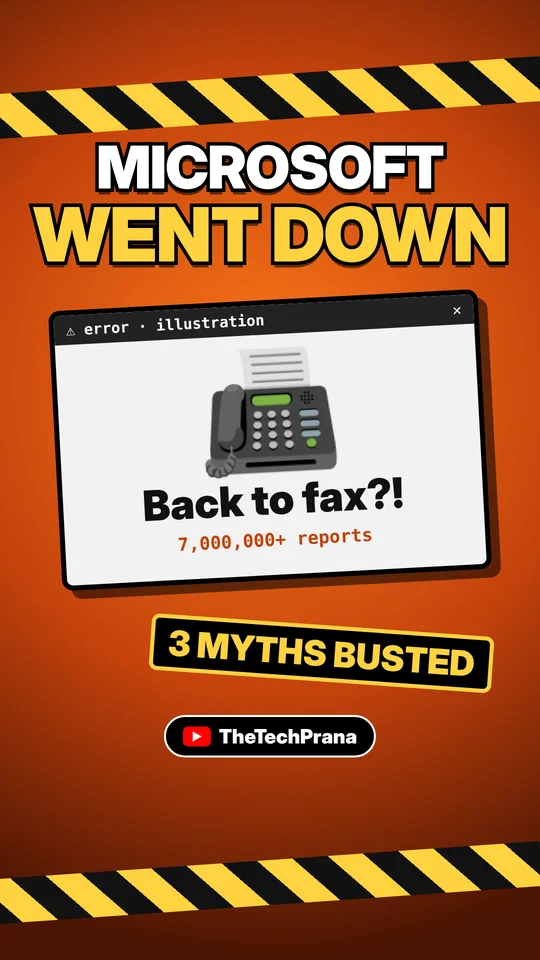
Watch the Short
The 60-second version is on YouTube. This article is the full story.
New Shorts every week on tech trivia, AI and gadgets.
Subscribe to TheTechPranaKey takeaways
- On 12 November 2026, Outlook, Teams and Copilot failed in more than 70 countries. Downdetector logged over 7 million reports.
- Microsoft says it wasn't a cyberattack and wasn't caused by AI agents. The impact lasted about a day.
- Preliminary cause: a hidden bug in the systems that set up secure connections, exposed by routine network maintenance. Microsoft rolled back a network change and said it's 'deeply sorry'.
On Thursday 12 November 2026, a huge part of the world’s work email simply stopped. Outlook wouldn’t load, Teams calls dropped, and Copilot went quiet. Some organisations were so stuck that they went back to fax machines.
Big outages always come with rumours. The Short above busts three of them. Here’s the full story.
What happened
- The trouble started around 16:00–17:30 UTC on 12 November (around 9:30–11 pm in India).
- Outlook / Exchange Online, Teams and Copilot failed for users in more than 70 countries.
- Outage tracker Downdetector logged over 7.4 million reports worldwide.
- Organisations that run their own Exchange email servers were largely unaffected – the problem was in Microsoft’s cloud.
Myth 1: “Hackers did it” – FALSE
When this many services fall over at once, many people’s first thought is a cyberattack. But Microsoft said there was no indication of malicious or cyber activity.
That matters: an attack would have raised questions about stolen data. A technical failure is disruptive, but it doesn’t mean your emails were accessed.
Myth 2: “Rogue AI agents broke it” – FALSE
With AI agents in the news (including stories of agents misbehaving), some people blamed AI. Microsoft ruled that out too, describing it as a technical issue not related to cyber or AI agents.
Myth 3: “It was over in minutes” – NOPE
This was no blip. Microsoft’s own impact window ran from about 16:20 UTC on 12 November to 16:10 UTC on 13 November – roughly 24 hours. Full restoration was reported by the morning of 14 November.
For businesses that run on Outlook and Teams, that meant a lost working day: missed meetings, stuck emails and, yes, the odd fax.
So what actually caused it?
Microsoft’s explanation so far is preliminary – its final post-incident report hadn’t been published at the time of writing. Here’s what it has said, in plain English:
- A hidden (“latent”) bug sat in the systems responsible for setting up secure connections – the step that happens before your app can talk to Microsoft’s servers safely.
- Routine network maintenance shifted traffic around, which exposed the bug.
- The affected servers ran out of capacity and couldn’t keep up.
- Microsoft reverted a recent network configuration change and gradually restored service.
Microsoft said it was “deeply sorry” for the disruption.
A familiar pattern
It’s not the first time this year. In July 2026, another Microsoft 365 and Azure outage was also traced to routine maintenance – that time, an error while isolating network paths in a US data-centre region. Maintenance is meant to keep systems healthy, but on a network this large, a small change can ripple around the world.
Why it matters
Most of us rarely think about where our email lives – until it disappears. A few takeaways:
- The cloud is someone else’s computer. When one provider has a bad day, millions of organisations do too.
- Have a plan B. A phone tree, a backup chat app or a shared status page can keep a team working when the main tools are down.
- Check the official status page first – for Microsoft 365, that’s the service health dashboard – before assuming you’ve been hacked.
Quick recap
- 12 Nov 2026: Outlook, Teams and Copilot fail in 70+ countries
- 7.4M+ Downdetector reports; some offices go back to fax
- Not a cyberattack, not AI agents
- About 24 hours of impact; fully restored by 14 Nov
- Preliminary cause: a hidden bug in secure-connection systems, exposed by network maintenance
We’ll update this post if Microsoft’s final report changes the explanation.
Your turn: did the outage hit you? Tell us in the YouTube comments.
Sources
- RTÉ: Microsoft gradually restoring service after global outage (13 Nov 2026)
- Al Jazeera: Microsoft hit by global outages – what happened and why? (13 Nov 2026)
- Wikipedia: 2026 Microsoft outage
- FourWeekMBA: Microsoft 365 root cause – latent bug behind outage (quotes Microsoft's service-health notes)
- BleepingComputer: Microsoft blames massive Microsoft 365 outage on maintenance bug (July 2026)