
Google's AI Told People to Put Glue on Pizza: The Story (and a 3-Question Quiz)
In May 2024, Google's AI Overviews suggested non-toxic glue in pizza sauce and eating rocks. Where those answers came from, and what Google changed.
 Abheek··5 min read
Watch the Short
The 60-second version is on YouTube. This article is the full story.
New Shorts every week on tech trivia, AI and gadgets.
Subscribe to TheTechPranaKey takeaways
- In May 2024, Google's new AI Overviews told a user to mix about ⅛ cup of non-toxic glue into pizza sauce so the cheese wouldn't slide off.
- The idea came from a joke Reddit comment written about 11 years earlier – and the AI repeated it almost word for word. A separate answer about eating rocks traced back to a satire website.
- Google said it limited forum posts and satire in AI Overviews, improved detection of nonsense questions, and showed AI answers for fewer kinds of searches.
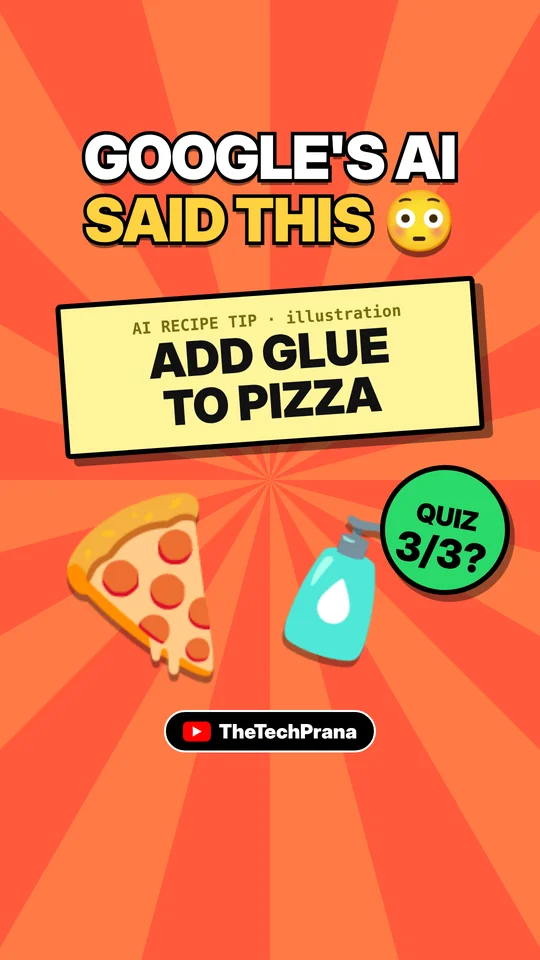
In May 2024, Google’s brand-new AI search feature gave one of the most famous wrong answers in AI history: put glue on your pizza.
The Short above turns it into a 3-question quiz. Try it first – then read the full story below.
The quick quiz (answers further down)
- How much glue did Google’s AI suggest? A few drops · ⅛ of a cup · A whole bottle
- Where did the AI get the idea? A cookbook · A joke Reddit comment · A famous chef
- What else did it tell people to eat? Rocks · Soap · Sand
What happened
On 14 May 2024, at its I/O conference, Google rolled out AI Overviews to everyone in the US. Instead of just a list of links, Google Search now showed an AI-written summary at the top of the results.
Within days, screenshots went viral. One user asked how to stop cheese sliding off pizza. The AI’s answer included this tip: mix about ⅛ cup of non-toxic glue into the sauce to give it more “tackiness.”
Answer 1: ⅛ of a cup. (Please don’t.)
Where did the glue idea come from?
The AI didn’t invent it. It found it.
The tip matched a joke comment on Reddit posted about 11 years earlier – and the AI repeated it almost word for word, as if it were genuine cooking advice.
Answer 2: a joke Reddit comment.
This is the key lesson. An AI summary is only as good as what it reads. The model couldn’t tell that a decade-old forum joke wasn’t a real kitchen tip.
And then there were the rocks
Another viral answer told people that eating rocks could be good for you, because rocks contain minerals – suggesting at least one small rock a day.
Google’s head of Search, Liz Reid, later explained that hardly anyone had ever asked “how many rocks should I eat?” – so for that rare question, the AI linked to the main page that had written about it: a satire website. Reports traced it to an article from The Onion.
Answer 3: rocks.
Google calls this kind of gap a “data void”: when very few reliable pages exist for an unusual question, the AI may lean on whatever it can find – even jokes.
Not everything viral was real
Reid also pointed out that some of the screenshots shared at the time were fakes that Google couldn’t reproduce. But the glue-on-pizza and eat-rocks answers were real.
What Google changed
In a blog post on 30 May 2024, Reid said Google had made more than a dozen technical improvements, including:
- Better detection of nonsense questions that shouldn’t get an AI Overview at all
- Limiting satire and humour content in AI answers
- Limiting user-generated content – like social media and forum posts – that could give misleading advice
- Showing AI Overviews for fewer kinds of searches where they weren’t helpful, including some health topics
How did you score?
- 3/3: AI chef. You can spot an AI fail from a mile away. 👨🍳
- 2/3: Close – the cheese only slid off a little. 🧀
- 0–1/3: Don’t worry – Google’s AI didn’t do much better. 🧴
The takeaway for using AI answers
- AI summaries can sound confident and still be wrong. They’re stitched together from web pages – including jokes, old forum posts and satire.
- Check the source link. If an AI answer points to a forum joke or a comedy site, that’s your clue.
- Be extra careful with food, health and money. These are exactly the areas where a confident wrong answer can hurt.
If you’d like to understand what these AI tools actually are, our explainer on AI vs agentic AI vs AGI is a good next read.
Your turn: what was your quiz score – 0, 1, 2 or 3? Tell us in the YouTube comments.
Sources
- Fortune: Google's AI search gives terrible advice (23 May 2024)
- Engadget: Google is putting more restrictions on AI Overviews after it told people to put glue on pizza (30 May 2024)
- TechCrunch: Google admits its AI Overviews need work (31 May 2024)
- Forbes Australia: Google restricts AI search tool after 'nonsensical' answers