
Today's AI Boom Started on 2 Gaming Graphics Cards: The AlexNet Story in 5 Numbers
In 2012, AlexNet trained on two Nvidia GTX 580 gaming cards in a student's bedroom and crushed the ImageNet challenge. The 5 numbers behind the AI turning point.
 Abheek··5 min read
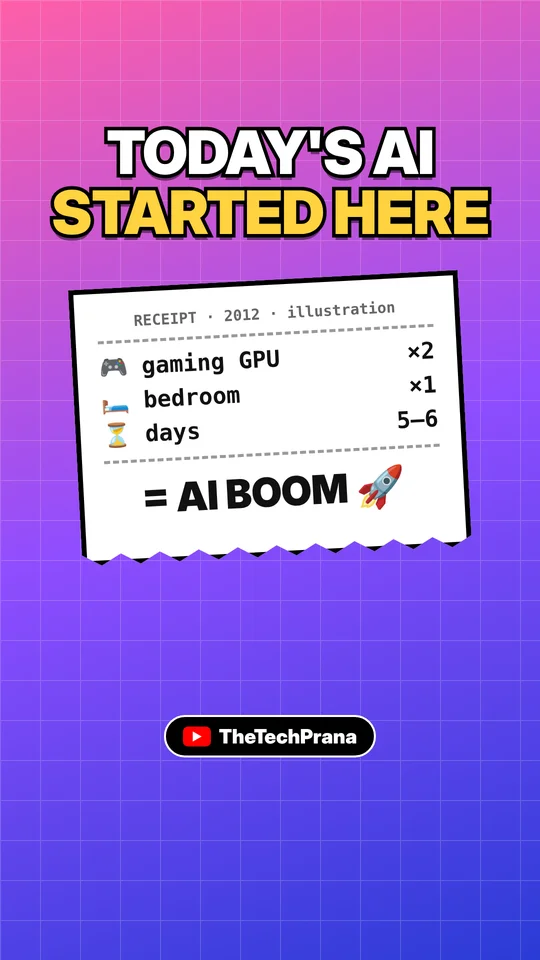
Watch the Short
The 60-second version is on YouTube. This article is the full story.
New Shorts every week on tech trivia, AI and gadgets.
Subscribe to TheTechPranaKey takeaways
- AlexNet (2012) trained for 5–6 days on two Nvidia GTX 580 gaming graphics cards with 3 GB of memory each.
- It had 60 million parameters, learned from about 1.2 million images, and won ImageNet 2012 with a 15.3% top-5 error versus 26.2% for the runner-up.
- It was trained on a home computer at Alex Krizhevsky's parents' house – and it's widely seen as the moment deep learning on GPUs took off.
ChatGPT, Gemini, Claude, AI image generators – today’s AI boom runs on giant data centres full of chips worth billions.
But the moment it all took off? Two gaming graphics cards, in a bedroom, in 2012.
The Short above counts it down in under 40 seconds. Here’s the story behind each number.
The setup: a contest nobody could crack
In the early 2010s, the big test for computer vision was the ImageNet challenge: show a program a photo and see if it can name what’s in it, out of 1,000 categories.
Progress was slow. Then in 2012, a team from the University of Toronto – grad students Alex Krizhevsky and Ilya Sutskever, with their advisor Geoffrey Hinton – entered a deep neural network called AlexNet.
Number 5: 5–6 days
That’s how long AlexNet took to train, according to the original paper. For a network that size in 2012, that was only possible because of the next number.
Number 4: 2 × GTX 580 (3 GB each)
AlexNet trained on two Nvidia GeForce GTX 580s – consumer cards sold for gaming, priced at around US$500 each when they launched.
The network was actually too big for one card’s 3 GB of memory, so Krizhevsky split it across both GPUs, with the two halves exchanging data only at certain layers. He also wrote his own GPU code (in Nvidia’s CUDA) to make training fast enough.
That’s the key idea: graphics cards are built to do huge amounts of simple maths in parallel – exactly what training a neural network needs.
Number 3: 60 million parameters
Parameters are the “knobs” a neural network tunes as it learns. AlexNet had 60 million of them and 650,000 neurons. That sounded huge in 2012 – today’s frontier AI models have billions or more, so AlexNet looks tiny by comparison.
Number 2: 1.2 million images
AlexNet learned from roughly 1.2 million labelled training images from ImageNet. Big data + big networks + GPUs: AlexNet was the first time all three came together, with spectacular results.
Number 1: 15.3% vs 26.2%
The result that shocked the field. AlexNet’s top-5 error (how often the right answer wasn’t in its top five guesses) was 15.3%. The runner-up scored 26.2%. Lower is better – so this wasn’t a small win, it was a different league.
It’s widely described as a turning point for computer vision – and the start of the deep-learning era that leads directly to today’s AI.
The twist: it was trained in a bedroom
The computer with the two graphics cards wasn’t in a university data centre. AlexNet was trained on a home computer at Krizhevsky’s parents’ house – usually described as his bedroom. The Computer History Museum even published a photo of that machine.
What happened next
- The three researchers soon started a company, which Google acquired, and Sutskever later co-founded OpenAI.
- GPUs became the engine of AI – a big reason Nvidia is one of the most valuable companies in the world today. (Our Nvidia money quiz has more on that.)
- In 2025, the Computer History Museum, working with Google, released AlexNet’s original source code as open source.
Why it matters
AlexNet proved that bigger neural networks, trained on lots of data with GPUs, beat hand-crafted methods. Almost every AI tool you use today follows that same recipe – just with thousands of chips instead of two.
Your turn: where do you code – bedroom, office, café or anywhere? Tell us in the YouTube comments.