

Introduction
Generative AI is surely making inroads across various sectors and the largest Cloud service provider cannot let this opportunity go by. So we’re going to take a look at how AWS is planning on utilizing Gen AI capabilities and embed in to their product portfolio to extract the best output. Most organizations have come to realize that a single Large Language Model (LLM) is not the answer instead have their own versions that are baked in to their existing solutions. This is the underlying factor for AWS as well to conceptualize, create Generative AI suite suite of capabilities to meet their business demands. Applications with native Generative AI capabilities that can be played around with along with competitive pricing and security is the need of the hour from AWS’s perspective. All these reasons are compelling enough for AWS to build their in house Generative AI stack.
Components of AWS Generative AI stack
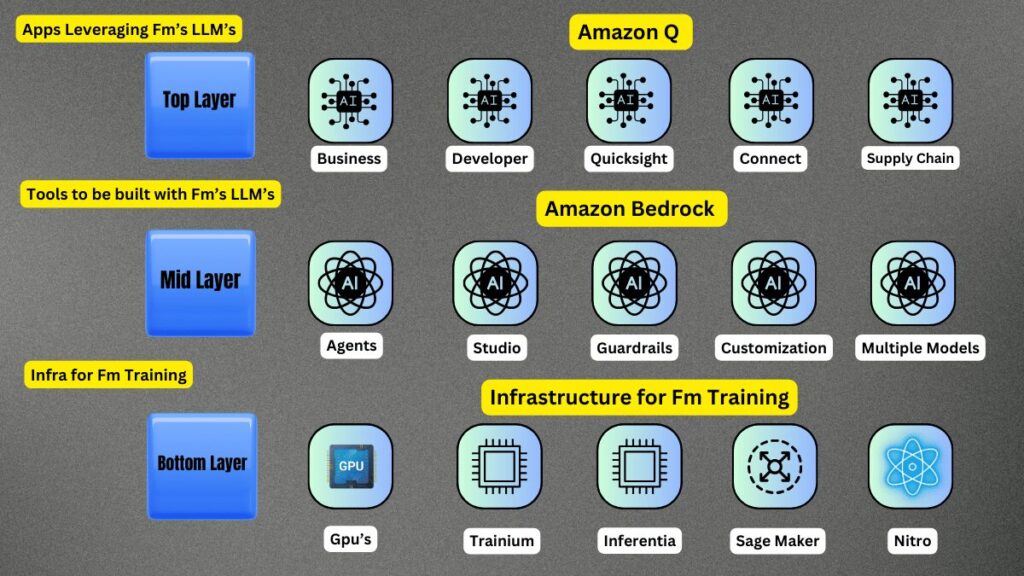
The top layer of the AWS Gen AI stack comprises of “Amazon Q” which is AWS’s Gen AI powered assistant. Think of it as AWS’s chatgpt. The middle layer has Amazon Bedrock, it’s purpose is to enable tools to easily and rapidly build, deploy, and scale generative AI applications. This is done by leveraging LLM’s and other Foundation models. Last, but not the least the bottom layer which is the Infrastructure layer that hosts the dedicated AI chips and Amazon Sage Maker to build and run Fm’s.
Amazon Q
Amazon Q easily and securely connects to over 40 commonly used business tools. These include wikis, intranets, Atlassian, Gmail, Microsoft Exchange, Salesforce, ServiceNow, Slack, and Amazon Simple Storage Service (Amazon S3). It is simple to point Amazon Q to your enterprise data and code repositories and see the magic. It searches all your data, summarizes logically, analyzes trends, and engages in dialogue with end users about the data.
This helps business users access all their data no matter where it resides in their organization. Amazon Q Developer is like a trusty sidekick for developers and IT professionals, tackling everything from coding, testing, and upgrading to troubleshooting, security scanning and fixes, optimizing AWS resources, and building data engineering pipelines. Amazon Q Developer agent can autonomously tackle a range of tasks—from implementing features, documenting, and refactoring code, to performing software upgrades. Need a new checkout feature for your e-commerce app? Just ask Amazon Q Developer, and it will analyze your codebase, map out a multi-file implementation plan, and upon your approval, execute all the required code changes and tests in minutes.
Amazon Bedrock
Amazon Bedrock is changing how generative AI applications are being built. It offers the broadest selection of first- and third-party foundation models (FMs). With user-friendly capabilities, Amazon Bedrock provides the fastest and easiest path to building and scaling secure generative AI applications.
Consequently, tens of thousands of customers now use Amazon Bedrock to build and scale impressive applications. They innovate quickly, easily, and securely to advance their AI strategies. To support their efforts, we continuously enhance Amazon Bedrock with exciting new capabilities. These include more model choices and features that simplify selecting the right model, customizing it for specific use cases, and safeguarding and scaling generative AI applications. The various models used are from AI21 Labs, Anthropic, Cohere, Meta, Mistral AI, and Stability AI, as well as our own Amazon Titan models. AWS are expanding model choices for customers by adding Meta Llama 3 models to Amazon Bedrock. The Llama 3 8B and Llama 3 70B models aim to responsibly scale generative AI applications. These models have significantly improved from the previous architecture, with enhanced pre-training and instruction fine-tuning approaches.
Amazon Sagemaker
Amazon SageMaker enables high-performance, low-cost machine learning for any use case as a fully managed service. With SageMaker, you can build, train, and deploy ML models at scale. Tools like notebooks, debuggers, profilers, pipelines, MLOps, and more—all in a single integrated development environment (IDE). SageMaker simplifies access control and provides transparency over your ML projects to support governance requirements. SageMaker’s tools help fine-tune, experiment with, retrain, and deploy large FMs trained on massive datasets. SageMaker provides access to hundreds of pre-trained models, including publicly available FMs, enabling easy deployment with just a few clicks. Data scientists and ML engineers use Amazon SageMaker to create FMs from scratch. They in turn assess and modify FMs using advanced techniques, implement FMs with precise controls for tgenerative AI applications. We all are aware of the stringent demands of the industry for accuracy, latency, and cost.
Conclusion
In conclusion, Generative AI technologies have the potential to revolutionize various industries. Furthermore, they offer innovative solutions to complex problems. AWS services like Amazon SageMaker help organizations harness Generative AI for advancements in image generation, text-to-image synthesis, and personalized recommendations. Utilizing AWS cloud infrastructure and machine learning tools keeps businesses at the forefront of innovation and unlocks new growth opportunities.