8 Skills AI Can't Replace (Yet) – What the 2026 Research Actually Says
Which skills are hardest for AI to replace? What Stanford, Microsoft, the WEF and LinkedIn found – and how students and young professionals can build them.
 Abheek··7 min read·
Key takeaways
- AI is very good at knowledge that's written down – facts, procedures, first drafts. It's much weaker at judgment, hands-on experience, and working with people.
- A Stanford study of US payroll data found young workers in jobs built on 'textbook' knowledge are being hired less, while experienced workers in jobs built on practice and know-how are doing fine.
- The safest plan isn't 'avoid AI'. It's human skills plus AI skills: employers rank analytical thinking as the top core skill, and AI and big data as the fastest-growing one.
“Will AI take my job?” is the wrong question. A better one is: which parts of my work can AI do, and which parts still need me?
The good news: researchers now have real data on this, not just predictions. The pattern is surprisingly clear. AI is excellent at knowledge that’s written down. It’s much weaker at the things you only learn by doing, deciding and dealing with people.
Here are the eight skills the evidence says are hardest to replace, and how to build them while you’re still a student or early in your career.
First, what the research found
Three big studies point the same way:
- Stanford (August 2026 update): Using US payroll data up to June 2026, researchers found that employment of 22–25-year-olds in the most AI-exposed jobs is about 19% below where it would be if it had kept pace with less-exposed jobs. Experienced workers show no such gap. The decline is in jobs built on codified knowledge (things you can learn from a textbook or a written procedure). Experienced people in jobs built on tacit knowledge (learned through practice and mentoring) saw employment rise. The authors stress these are patterns, not proof of cause, and the effect shows up as fewer hires, not layoffs.
- Microsoft Research (2025): After studying 200,000 real Copilot conversations, researchers found AI helps most with research, writing and communication tasks. But they said it doesn’t fully perform any single occupation. The jobs it applied to least were healthcare support and physical work, like construction and farming.
- Anthropic Economic Index (January 2026): Claude succeeds at most tasks people give it, but its success rate falls as tasks get longer and more complex.
So AI is a strong assistant for well-defined, text-based work. The skills below are what’s left when you take that away.
The 8 skills AI can’t easily replace
1. Judgment – making the call and owning it
AI can list five options. It can’t take responsibility for choosing one. Deciding what to do when the information is incomplete, the stakes are real and someone has to be accountable is still a human job. That’s true whether it’s a doctor’s diagnosis, a manager’s hiring decision or an engineer signing off a release.
Build it: Volunteer for decisions, even small ones: choosing a project’s tech stack, a college fest budget, a team plan. Write down why you chose, then check later whether you were right.
2. Hands-on, tacit experience
This is the Stanford finding in one line: knowledge you can only get from doing the work is the hardest for AI to copy. Examples include knowing which client gets anxious before a launch, how a production system really fails at 2 a.m., or how a machine sounds just before it breaks.
Build it: Internships, real projects, part-time work, open-source contributions, shadowing seniors. Every hour of practice is something a chatbot can’t download.
3. Working with people – communication and empathy
Economist David Deming showed that nearly all job growth in the US since 1980 has been in jobs that need strong social skills. The pay for those skills has grown too. His explanation still holds: computers are poor at real human interaction. Calming an upset customer, reading a room, explaining bad news kindly, and getting two teams to agree all fall in that category.
Build it: Present in class, run a club, handle customer queries, mentor juniors. Ask for honest feedback on how you come across.
4. Leadership and influence
The World Economic Forum’s 2025 survey of 1,000+ employers ranks leadership and social influence among the top core skills. Getting people to move in one direction, without any AI tool doing it for you, is a skill that compounds over a whole career.
Build it: Lead something small first: a study group, a hackathon team, a volunteer drive. Leadership is learned by doing it badly and improving.
5. Analytical thinking – asking the right question and checking the answer
Seven in ten employers in the WEF survey call analytical thinking an essential core skill, the most-cited of all. With AI, it matters even more. Someone has to frame the problem properly, then spot when the confident-sounding answer is wrong.
Build it: Whenever you use AI, verify one claim against a real source. Practise breaking big problems into smaller ones. Learn basic data skills (SQL and spreadsheets) so you can test ideas with numbers.
6. Creative thinking
AI can remix what already exists. Spotting a new problem, connecting two unrelated ideas, or deciding what’s worth making at all is still where people lead. The WEF expects creative thinking to keep growing in importance to 2030.
Build it: Make things: videos, apps, designs, writing. Use AI for the first draft if you like, but make sure the idea and the final call are yours.
7. Adaptability and lifelong learning
The WEF expects 39% of workers’ existing skills to change or become outdated between 2025 and 2030. Resilience, flexibility, curiosity and lifelong learning are among the skills it expects to keep rising. The person who learns the next tool fastest stays useful whatever the next tool is.
Build it: Learn one new thing a month and actually use it in a project. Treat every new AI tool as something to try, not something to fear.
8. Physical and care skills
Microsoft’s study found AI chatbots apply least to healthcare support and physical work: nursing assistants, technicians, construction, maintenance, field operations. A chatbot can’t fix a pipeline, comfort a patient or wire a data centre. Robotics may change some of this over time, but far more slowly than software.
Build it: If you enjoy hands-on work, certifications in healthcare, electrical, networking hardware or field engineering are a real advantage, not a “Plan B”.
But don’t skip the AI skills
“Skills AI can’t replace” doesn’t mean “ignore AI”. The same WEF report names AI and big data as the fastest-growing skill to 2030, followed by networks and cybersecurity and technology literacy. In India, LinkedIn’s Skills on the Rise 2026 puts AI and automation first among its five skill stacks, alongside data and analytics, IT and cybersecurity, business and growth, and people and leadership.
The winning combination is human skills + AI skills. Use AI for the codified parts of your work, and spend the time you save on judgment, people and hands-on experience.
What this means if you’re a student or just starting out
The Stanford data shows the pressure is on entry-level hiring in jobs built on written-down knowledge. That doesn’t make those careers a bad choice, but it changes how you should prepare:
- Don’t rely on your degree alone. It gives you codified knowledge, which is exactly the part AI handles well. Add proof of real work: projects, internships, a portfolio.
- Get close to experienced people. Tacit knowledge passes through mentoring. Ask to shadow, review, sit in on calls.
- Show judgment in interviews. Talk about decisions you made and what you learned, not just tools you know.
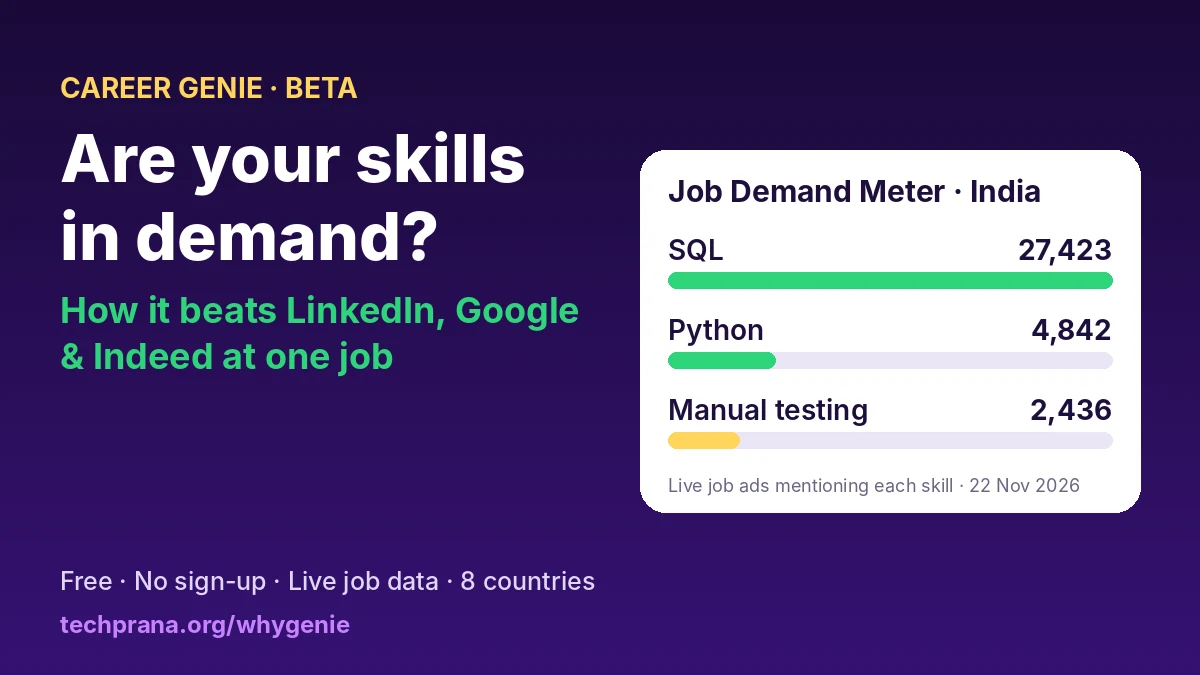
- Check what employers are asking for. Skill demand changes fast. Career Genie shows how many live job ads mention your skills right now, in 8 countries. It’s free, with no sign-up.
The bottom line
AI is taking over the parts of work that can be written down. That pushes value towards everything that can’t: judgment, experience, people, leadership, and the curiosity to keep learning. None of these is “safe forever”, and the research is early, but these are the skills the evidence says to build first.
👉 Check which of your skills employers want right now – Career Genie
Want weekly updates on rising skills and AI at work? Follow TechPrana on WhatsApp.
Sources
- Stanford Digital Economy Lab: Canaries in the Coal Mine? – revised August 2026 (codified vs tacit knowledge)
- Stanford Digital Economy Lab: Canaries in the Coal Mine? Six Facts about the Recent Employment Effects of AI
- Microsoft Research: Working with AI – Measuring the Occupational Implications of Generative AI (Tomlinson et al., 2025)
- The Register: Microsoft researchers on the jobs most and least affected by AI (Jul 2025)
- World Economic Forum: The Future of Jobs Report 2025 – Digest
- World Economic Forum: Future of Jobs Report 2025 press release (170M jobs created, 92M displaced)
- Anthropic Economic Index report: Economic primitives (Jan 2026)
- David J. Deming: The Growing Importance of Social Skills in the Labor Market (NBER / QJE)
- BW People: LinkedIn Skills on the Rise 2026 – India's five skill stacks