

Introduction
Microservices architecture, often called microservices, lets you break down a large application into smaller, independent parts, each with its own responsibility. To handle a single user request, a microservices-based application can call on many internal microservices to craft its response, like a team of superheroes assembling to save the day! Containers perfectly illustrate microservices architecture, allowing you to focus on developing services without worrying about dependencies. Modern cloud-native applications typically use containers to build microservices. Below picture represents a typical monolithic architecture as opposed to Microservices architecture. Containers are a well-suited microservices architecture example, since they let you focus on developing the services without worrying about the dependencies. Modern cloud-native applications are usually built as microservices using containers.
What is Microservice architecture used for?
Developers typically use microservices to speed up application development. Microservices architectures built with Java, especially Spring Boot, are common. Comparing microservices to service-oriented architecture is also common; both aim to break up monolithic applications into smaller components but use different approaches. Here are some examples of microservices architecture:
- Website Migration
- Media Content
- Financial transactions
- Data Processing
Understanding the Microservice Architecture
In a monolithic application, all processes depend heavily on each other and function as a single service. When demand for the bandwidth of any one process increases, you need to scale up the entire architecture. As the code in a monolithic application is deployed together on a single base, adding or improving features can become complex, particularly as the code base grows in size and intricacy. Moreover, monolithic applications are prone to failure because tightly coupled, interdependent processes can be impacted if one process experiences issues.
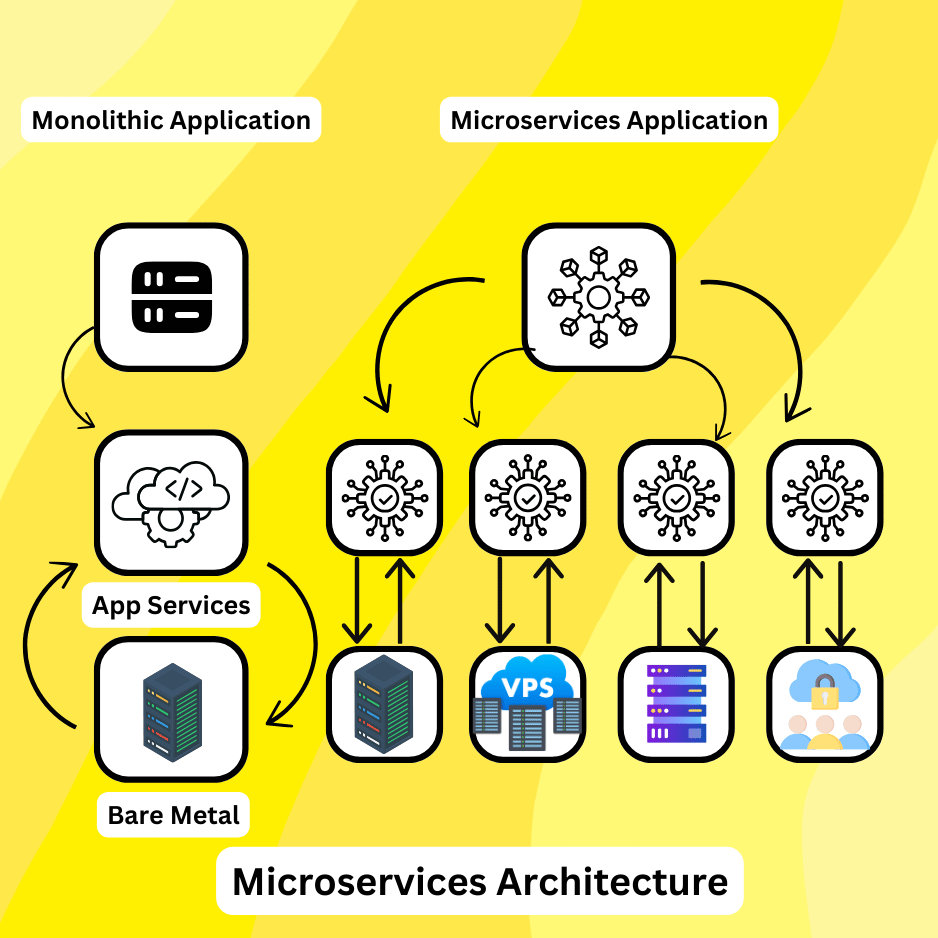
This setup shackles experimentation, making it hard for enterprises to stay nimble and responsive, which is a big disadvantage in a fast-paced, customer-centric market. Microservices come to the rescue by breaking down large applications into smaller, independent pieces. Each piece handles its own responsibilities, blissfully unaware of what the others are up to. When a user request comes in, a microservices-based application rallies these pieces together to get the job done. In a microservices architecture, the services engage in chit-chat through nimble APIs linking to intricate interfaces. Crafted for specific business tasks like money magic, invoice origami, and data wizardry, each service handles a solo mission. Running solo enables them to hit the town, get a facelift, and flex their muscles as per the demand for their special talents 😂
Characteristics of Microservice Architecture
Multiple components
By definition, microservices architecture breaks software into numerous component services. You can create, deploy, and update each service independently without compromising the application’s integrity. Scaling up the entire application becomes a breeze by tweaking a few specific services instead of taking it down and redeploying everything.
Robust operations with reduced failures
An application built using a microservices architecture rarely fails completely. However, individual services can fail, undoubtedly affecting operations. In a microservices environment, numerous diverse and unique services communicate with each other to carry out operations, making occasional failures inevitable.
Simplified routing
In the wacky world of microservices, you’ve got brainy components crunching data and solving puzzles. But here’s the twist: they’re linked by ‘dumb wires’ that pass info around.
Meanwhile, in the land of enterprise apps, you’ve got the flashy enterprise service bus with all its fancy routing gymnastics. Microservices? They just chill, get a request, do their thing, and shoot back the goods.
Decentralized operations
Microservices tap into a variety of platforms and technologies, rendering traditional centralized governance methods inefficient.
Decentralized governance works better for microservices, allowing developers worldwide to create valuable tools for operational challenges. These tools can then be shared and used by other developers facing similar issues. Likewise, microservices architecture prefers decentralized data management, with each microservice managing its own unique database. In contrast, monolithic systems usually rely on a centralized logical database for all applications.
Next Gen Business ready solutions
The microservices architecture is designed to address the needs of contemporary digital enterprises. Unlike traditional monolithic architectures where separate teams handle development tasks like UI, technology layers, databases, and server-side logic, microservices leverage cross-functional teams. Each team assumes accountability for developing distinct products associated with individual services that communicate through a message bus.
Conclusion
Microservices architecture revolutionizes application development by breaking down large systems into smaller, independently manageable services. This approach enhances scalability, flexibility, and resilience, allowing developers to innovate and deploy updates without disrupting the entire application. By fostering decentralized governance and data management, microservices architecture enables rapid response to market changes and operational challenges, making it an ideal solution for modern, dynamic business environments.