

Introduction
The global Machine Learning (ML) landscape was valued at $19.20 billion in 2022. Experts expect it to grow from $26.03 billion in 2023 to $225.91 billion by 2030, with a CAGR of 36.2%. In the US, machine learning engineer jobs are projected to grow by 31% from 2019 to 2029, much faster than average. The statistics obviously are in favor of machine learning and there are more than likely chances of succeeding in a career in machine learning. So, how do you go about adding machine learning skills in your arsenal? We will try to take a comprehensive look at the path to skill up with Machine learning. So let’s get started
Step by Step guide
While growing up I think most of us never thought of a computer who could learn like humans, did we? Voila, that’s a reality. Machine learning is a subset of AI that enables a computer/machine to take decisions based on supporting data. Machine learning leverages statistical models and algorithms that help systems to improve gradually through experience and influx of large amounts of data. We will try to envision a ML Ops road-map with the help of the below visual
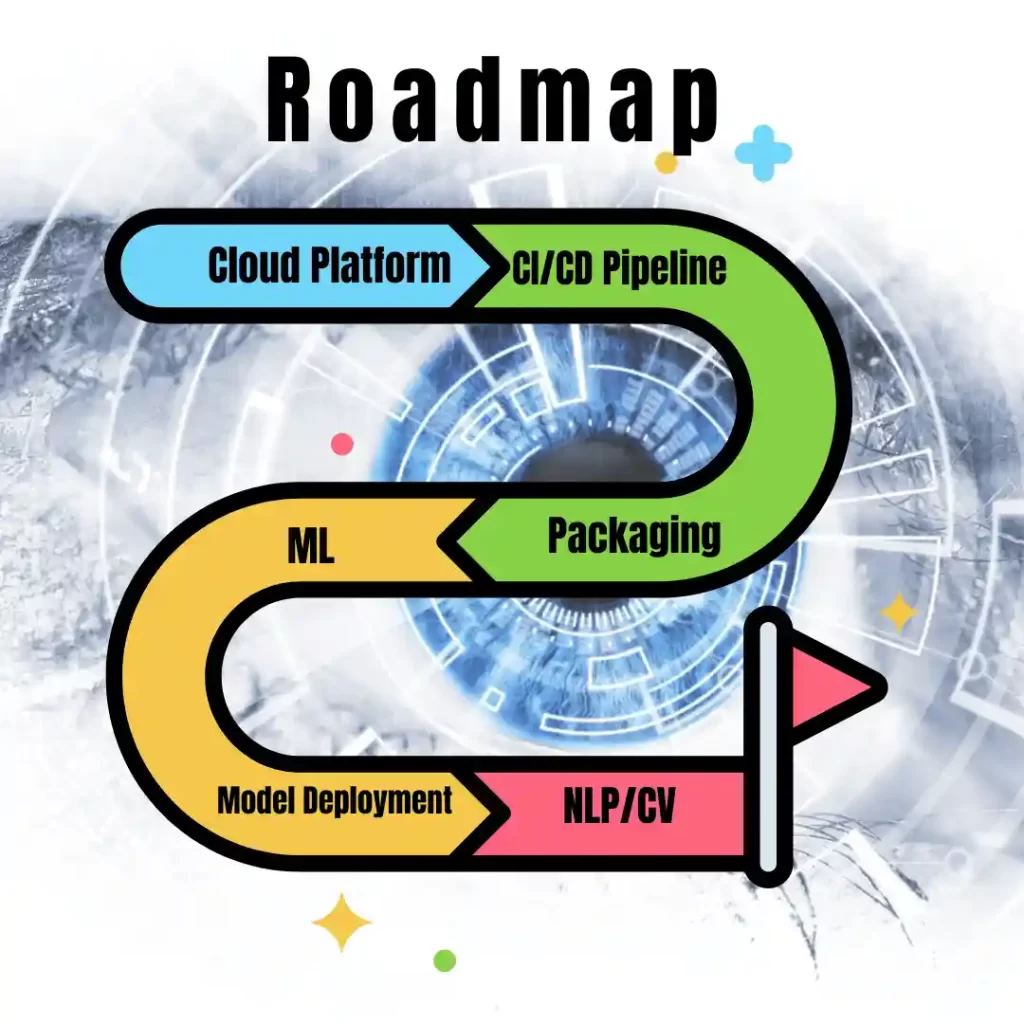
As seen from the above visual, understanding of a cloud platform is the first milestone followed by CI/CD pipeline. Know “Packaging” and followed by Machine learning and finally deploying a model with NLP (Natural language processing) and CV (Computer vision). We will touch these topics later.
1. Strong Mathematical Foundation
It is imperative to have a good grasp on mathematics especially Linear algebra and calculus which in turn will contribute to an understanding for algorithms. The role of calculus in machine learning is formulating functions that train algorithms. Here are the topics you should first target to learn:
Linear Algebra
- Vectors and matrices
- Linear equations
- Eigenvalues and eigenvectors
- Matrix transpose and inverse
- Matrix multiplication and factorization
- Linear transformations
- Linear regression
Calculus
- Differential and integral calculus
- Differentiation (limit, continuity, partial derivatives)
- Multi variable calculus
- Integration
- Gradient descent
- Maxima and minima of a function
- Step, logit, sigmoid and ReLU function
Probability and Statistics
Probability and statistics are fundamental in machine learning and data analytics. They analyze data, draw meaningful insights, and make informed decisions. Probability theory also applies in fields such as finance, weather forecasting, and genetics. Understanding statistics helps quantify uncertainty, identify data patterns, and make predictions based on trends. It supports experimental design and hypothesis testing, crucial for drawing reliable conclusions from data. Below topics are important starting points:
- Probability Distributions (Normal, Binomial, Poisson, etc.)
- Descriptive Statistics (Mean, Median, Standard Deviation)
- Hypothesis Testing (Null Hypothesis, p-value)
- Statistical Learning Theory (Bias-Variance Tradeoff)
- Bayesian Statistics (optional, but useful for certain applications)
- Regression Analysis
- Conditional Probability
2. Programming
- Python: Python is widely popular because of its simplicity and vast libraries like NumPy, pandas, and scikit-learn. Its ease of use makes it an excellent choice for beginners and experts alike. Moreover, its versatility allows easy integration with other languages and tools. Consequently, it remains a favorite among data scientists and machine learning practitioners.
3. Machine learning algorithms
Once you solidify your mathematical foundation and programming skills, master core machine learning algorithms. Understanding these algorithms empowers you to apply them effectively to various real-world problems. Explore below mentioned key algorithms:
- Unsupervised learning algorithms: In unsupervised learning, you give the algorithm input data without explicit instructions. The algorithm then tries to find patterns, structures, or relationships in the data without labeled output for guidance.
- Supervised learning algorithms: When you train an algorithm on a labeled dataset, where the input data is paired with corresponding output labels, you are using supervised learning.
- Model evaluation and validation: This step assesses the performance and reliability of your machine learning models. Learn evaluation metrics like accuracy, precision, recall, and F1 score for classification, and MSE or RMSE for regression. Understand the importance of cross-validation and performance metrics
- Other important machine learning algos: Reinforcement learning, gradient descent and slope are important algorithms to learn
4. Advanced machine learning algorithms
After you learn the elementary topics described earlier, this should be the time to dig deeper into advanced topics. These topics will enhance your understanding and enable you to solve complex problems. Some of the important topics are as below:
- Deep learning and neural networks
- Ensemble Learning Techniques
- Generative models and adversarial learning
- Recommendation systems and collaborative filtering
- Time series analysis and forecasting
5. Deployment
This step centers on the essential phase of deploying your machine learning models for practical use. You will explore various technologies and platforms that facilitate model hosting, monitoring, and maintenance, ensuring your models are accessible, scalable, and seamlessly integrated into applications or systems. In depth understanding of the technologies mentioned below would be beneficial:
- Flask
- Django
- Cloud Services
- Stremlit & FastAPI
- Docker & Kubernetes
6. Demonstrating your learning
Participate in projects within your organization or outside to demonstrate your ideas and learnings. Working on real-world projects is the best way to solidify your understanding and gain practical experience in machine learning. These projects allow you to apply your knowledge and showcase your skills to potential employers. Gather and re-purposing data, a critical foundation for any machine learning project. Focus on techniques for handling missing data, encoding categorical variables, and normalizing data. Projects like fraud detection systems, image recognition are some of the examples. Compile your projects into a professional portfolio to showcase your proficiency and experience in machine learning. Use platforms like GitHub to present your work effectively.
Conclusion
Machine learning evolves rapidly, making it crucial to stay updated with the latest developments. To maintain your edge, engage in continuous learning and exploration. Follow key influencers and researchers, and network with machine learning experts on platforms like Twitter and LinkedIn. These hubs share cutting-edge research papers, insightful articles, and thought-provoking discussions, keeping you at the forefront of the machine learning field. Actively participate in personal projects or competitions. This approach lets you test your skills, explore new concepts, and build a portfolio that showcases your capabilities to potential employers.