
Why Are Airplane Windows Round? The Comet Crashes That Changed Aviation
Plane windows are round because of the de Havilland Comet, the first jet airliner. Here's how metal fatigue and sharp corners taught engineers a deadly lesson.
 Abheek··5 min read
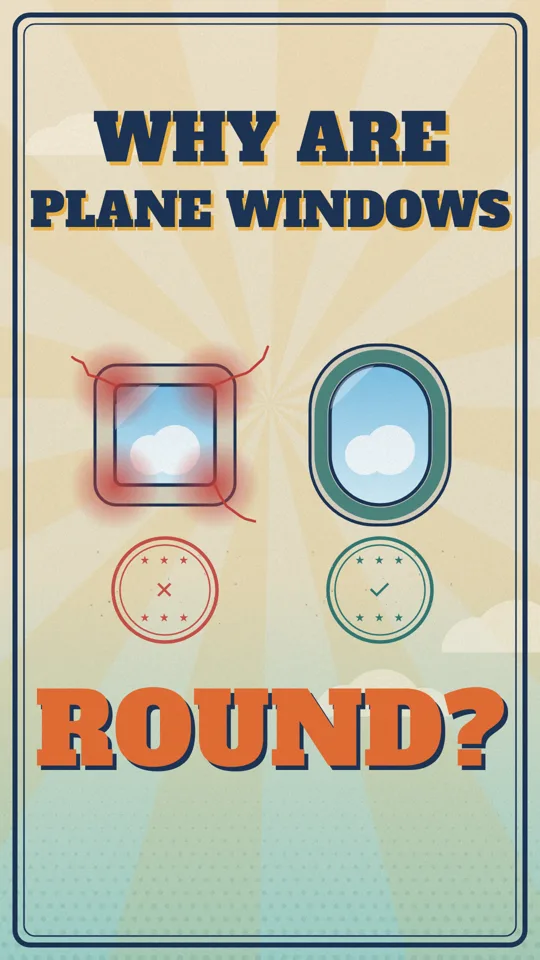
Watch the Short
The 60-second version is on YouTube. This article is the full story.
New Shorts every week on tech trivia, AI and gadgets.
Subscribe to TheTechPranaKey takeaways
- The de Havilland Comet became the world's first jet airliner in 1952 – and two Comets broke apart in mid-air in 1954.
- Engineers tested a Comet fuselage in a water tank, pressurising it again and again. It burst after about 3,000 cycles, with cracks starting at sharp corners.
- Sharp corners concentrate stress; curves spread it out. That's why every window and cutout on a modern airliner is rounded.
Next time you fly, look at the window next to your seat. It has rounded corners – every passenger window on every modern airliner does. That shape isn’t a style choice. It’s a lesson the aviation industry learned the hard way, from the very first jet airliner ever built.
The world’s first jet airliner
The de Havilland Comet was a British marvel. It first flew in 1949 and entered commercial service with BOAC on 2 May 1952, flying London to Johannesburg. Compared with the propeller planes of the day, it was fast, high-flying and remarkably smooth and quiet. For a moment, Britain led the world in jet travel.
Then the Comets started breaking apart
In early 1954, disaster struck twice:
- 10 January 1954: BOAC Flight 781 broke up over the Mediterranean near the island of Elba.
- 8 April 1954: South African Airways Flight 201 broke up near Naples.
Both aircraft came apart in mid-air at cruising altitude. The entire Comet fleet was grounded, and investigators had to answer a frightening question: why was a brand-new airliner falling apart?
The water-tank test
Engineers at the Royal Aircraft Establishment in Farnborough came up with a clever experiment. They placed a complete Comet fuselage in a huge water tank and pressurised it over and over again. Each cycle mimicked one flight: the cabin is pressurised as the plane climbs, then released as it lands.
Using water rather than air was a safety choice – if the fuselage burst, water wouldn’t explode outward the way compressed air would.
The fuselage eventually burst after about 3,000 cycles (3,057, counting the flights it had already made in real service). The cracks had started at the sharp corners of the plane’s nearly square cutouts.
Why corners are dangerous: metal fatigue
The culprit was metal fatigue. Metal that is bent or stretched again and again – even by forces well below what would break it in one go – slowly develops tiny cracks. Each flight, the cabin “breathes” in and out a little as it’s pressurised and depressurised.
The key insight was where the cracks formed:
- At a sharp corner, stress piles up in one small spot, many times higher than in the rest of the panel.
- Along a curve, the same stress is spread out evenly, with no single weak point.
The Comet’s designers had underestimated how much stress those sharp corners would concentrate. Repeated pressurisation turned those hot spots into cracks, and the cracks into catastrophic failures.
A detail most versions get wrong
The popular version of the story says “square passenger windows made the Comet crash.” It’s close, but not quite right. The investigation traced the failure to the corners of near-square cutouts in the roof – an escape hatch and a window for the radio-navigation antenna – rather than the passenger windows themselves.
The lesson, though, applied to every opening in the fuselage: no sharp corners. Passenger windows included.
The legacy
De Havilland redesigned the aircraft with rounded windows, thicker skin and a stronger structure. The Comet 4 returned to service in 1958 and flew safely – but by then rivals such as the Boeing 707 had arrived and taken the market.
The Comet’s real legacy is in every plane you board today: rounded windows, better fatigue testing and “fail-safe” structures designed so that one crack can’t bring down an aircraft. The first jet airliner paid a terrible price so that everyone after it could fly more safely.
Quiz time: did you guess the real reason before reading this? Watch the Short above and drop your score in the YouTube comments.