
6 Nintendo Myths Busted: Older Than the Airplane, Taxis, Love Hotels and More
Nintendo began in 1889 making playing cards, ran a taxi firm and sold instant rice. But did it run love hotels? 6 Nintendo myths and facts, checked.
 Abheek··6 min read
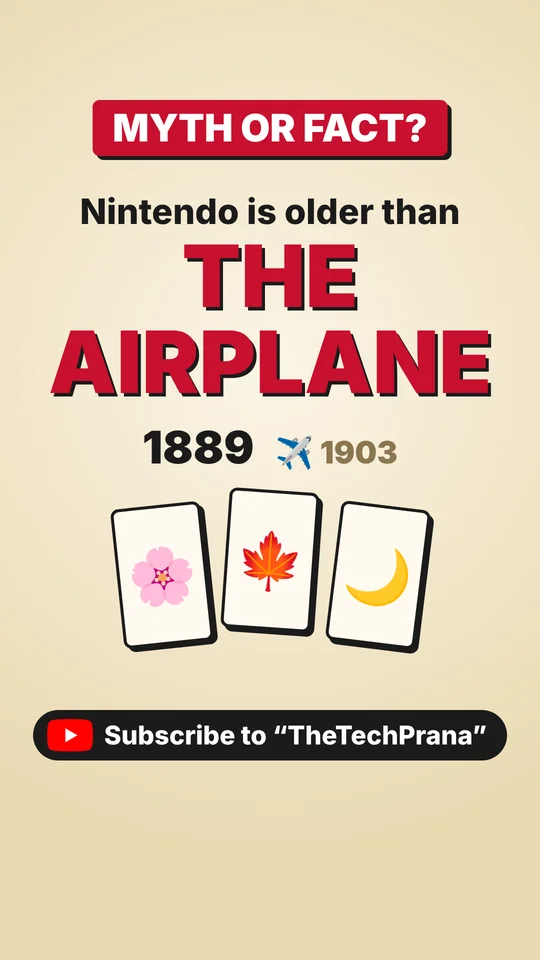
Watch the Short
The 60-second version is on YouTube. This article is the full story.
New Shorts every week on tech trivia, AI and gadgets.
Subscribe to TheTechPranaKey takeaways
- Nintendo was founded in Kyoto in 1889 to make hanafuda playing cards – 14 years before the Wright brothers' first powered flight.
- In the 1960s it really did run a taxi company and sell instant rice, before a factory engineer's toy, the Ultra Hand, pointed it towards games.
- The famous 'Nintendo love hotels' story is almost certainly a myth that traces back to a single 1993 book.
Nintendo is the company behind Mario, Zelda and Pokémon. It’s also older than the airplane – and much of what people “know” about its strange early years isn’t quite true.
The Short above runs through six claims. Here’s the full story behind each verdict.
Myth 1: “Nintendo started in 1889” – FACT
Nintendo was founded by Fusajiro Yamauchi in Kyoto, Japan, on 23 September 1889.
The Wright brothers made the first powered airplane flight on 17 December 1903 – 14 years later. So yes, Nintendo is older than the airplane (gliders and balloons had flown before, but not powered planes).
The company has been headquartered in Kyoto ever since.
Myth 2: “It started out making toys” – MYTH
Nintendo’s first product wasn’t a toy. It was hanafuda, or “flower cards” – a traditional Japanese card game.
A hanafuda deck has 48 cards in 12 suits, one for each month, each decorated with a plant or scene from that time of year: cherry blossoms for March, the moon for August, maple leaves for October.
Yamauchi’s cards were handmade and hand-painted, and they sold well. In 1902, Nintendo also started making Western-style playing cards.
The cards that changed everything
Fusajiro’s grandson, Hiroshi Yamauchi, took over in 1949 at just 22. In 1959 he struck a deal with Disney to print Mickey Mouse and friends on Nintendo’s cards. Until then, playing cards in Japan were seen mostly as a tool for gambling. Disney characters turned them into a family product, and Nintendo sold at least 600,000 packs in a year.
Myth 3: “Nintendo ran a taxi company” – FACT
This one sounds made up, but it’s true. In the 1960s, Hiroshi Yamauchi worried that playing cards alone couldn’t support the company, so Nintendo tried several very different businesses:
- Daiya Taxi, a taxi company in Kyoto, launched around 1960. It was later sold, reportedly over difficulties with the drivers’ union.
- Instant rice and other food products.
- A vacuum cleaner called the Chiritory.
Most of these didn’t last. What finally worked came from inside its own card factory.
The toy that pointed the way
Around 1966, Yamauchi was touring a hanafuda factory when he noticed a maintenance engineer, Gunpei Yokoi, playing with an extending grabber arm he had built for fun in his spare time.
Instead of telling him off, Yamauchi told him to turn it into a product. The result, the Ultra Hand, sold over a million units and became one of Nintendo’s first big toy hits. Yokoi moved into product development and went on to create the Game & Watch and the Game Boy. Nintendo had found its future: play.
Myth 4: “Nintendo ran love hotels” – ALMOST CERTAINLY A MYTH
This is the most famous Nintendo “fact” online, and it’s almost certainly wrong.
The story says that, in the 1960s, Nintendo ran a chain of love hotels – short-stay hotels for couples, common in Japan. But it appears to trace back to a single source: a passage in David Sheff’s 1993 book Game Over, a history of Nintendo. Every article and video repeating it seems to lead back to that one paragraph.
In July 2026 the story resurfaced. Famicom archivist Orochi found working FamicomBox units – a commercial version of Nintendo’s 1986 console made for places like hotels – in almost every room of a Japanese love hotel. That’s real, but it’s Nintendo selling consoles to hotels, not running them.
Orochi looked into the myth itself and found no evidence: if Nintendo had run love hotels, it should show up in the company’s official securities reports, and it doesn’t. Nintendo historian Isao Yamazaki also said he believes it’s very unlikely.
We say “almost certainly” rather than “definitely” because those detailed records only go back to 1962, so it can’t be completely ruled out before then.
Myth 5: “Nintendo means ‘leave luck to heaven’” – UNCONFIRMED
You’ll see this translation everywhere. It’s a popular reading of the characters in Nintendo’s Japanese name, 任天堂, often interpreted as “leave luck to heaven”.
The problem is that there’s no historical record of the founder explaining what he meant by the name. It’s a nice story, and it fits a company that started with games of chance, but it’s an interpretation, not a documented fact.
Myth 6: “Nintendo still makes playing cards” – FACT
137 years later, Nintendo still makes hanafuda. You can buy its traditional decks today – including Mario-themed versions, which put Nintendo characters on the classic flower designs.
Your scorecard
| # | Claim | Verdict |
|---|---|---|
| 1 | Nintendo started in 1889 | ✅ Fact |
| 2 | It started out making toys | ❌ Myth – it made hanafuda cards |
| 3 | It ran a taxi company | ✅ Fact – Daiya Taxi, 1960 |
| 4 | It ran love hotels | ❌ Almost certainly a myth |
| 5 | The name means “leave luck to heaven” | ❓ Unconfirmed |
| 6 | It still makes playing cards | ✅ Fact |
How many did you get right? Watch the Short above, and tell us your score out of 6 in the YouTube comments.
Sources
- Wikipedia: History of Nintendo
- Wikipedia: Hanafuda
- Automaton: Nintendo's rare commercial-only Famicom model found in a Japanese love hotel, rekindling the urban myth (24 July 2026)
- Kotaku: Rare Nintendo console discovered throughout Japanese love hotel
- Kotaku: Nintendo's hanafuda cards
- History Skills: How Nintendo survived World War II and transformed into a gaming powerhouse