

Introduction
In the vast landscape of web servers, one name has been steadily climbing the ranks: Nginx (pronounced “engine-x”). With over 400 million websites now powered by this versatile software, it’s clear that Nginx has become a force to be reckoned with. But what’s behind this phenomenal growth?
Let’s dive into the world of Nginx and uncover why it’s become the go-to choice for so many websites, from small personal blogs to tech giants. Known for its speed, stability, and low resource consumption, NGINX excels in handling a high volume of connections with efficiency and ease. Moreover, it functions not only as a web server but also as a load balancer, HTTP cache, and mail proxy. Consequently, it has become a popular choice for powering some of the world’s busiest websites.
Deep dive- Nginx
Web servers are fundamental units of the internet, built to deliver requested webpages. Each web server has an IP address and a domain name. To transform your computer into a web server, you need to install web server software like NGINX, XAMPP, Apache, Tornado, Caddy, or Microsoft Internet Information Services (IIS)Developers use NGINX, an open-source web server software, for reverse proxy, load balancing, and caching. It offers HTTPS server capabilities and is primarily designed for maximum performance and stability. Additionally, it functions as a proxy server for email communication protocols like IMAP, POP3, and SMTP.
NGINX architecture
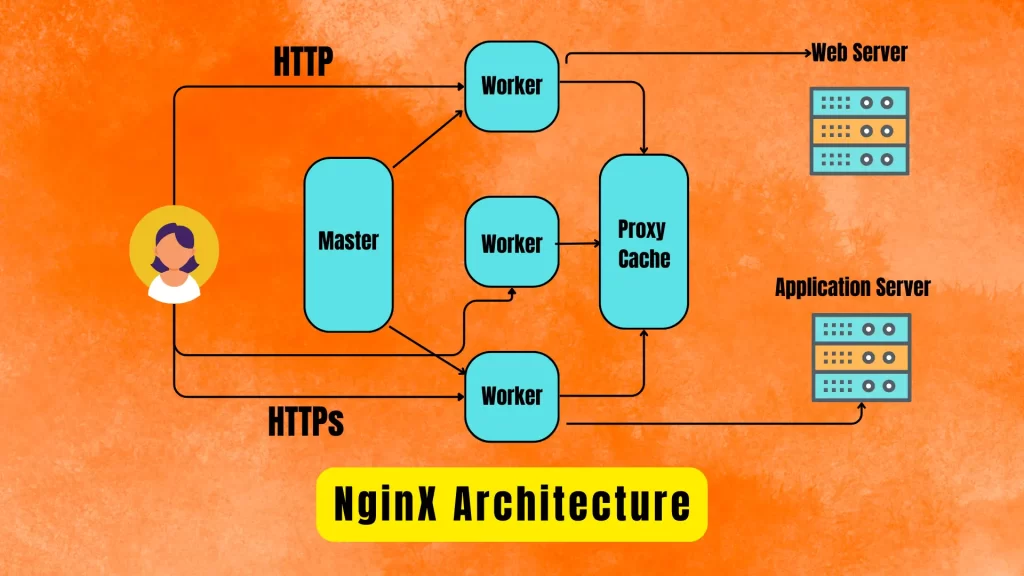
NGINX implements event-driven, asynchronous, and non-blocking models using a master-slave architecture. It also employs an advanced event-based mechanism in many operating systems. Additionally, NGINX utilizes multiplexing and event notifications, dedicating specific tasks to separate processes. For instance, if there are 10 tasks, 10 different processes will handle each one. NGINX processes highly efficient run loops in single-thread processes called workers.
- Workers: They grab new requests from a shared listen socket and zip through highly efficient run loops, processing thousands of requests like it’s a walk in the park
- Masters: Masters strut their stuff by reading and validating configurations, creating and binding sockets, and orchestrating the start, termination, and maintenance of worker processes. They even pull off the nifty trick of re configuring worker processes without missing a beat.
- Proxy caches: Proxy caches get the VIP treatment as special processes, boasting a cache loader and manager. The cache loader scouts out disk cache items and fills up the engine’s in-memory database with cache metadata, prepping NGINX instances to tango with files already on the disk. The cache manager, ever the diligent housekeeper, takes care of cache expiration and invalidation.
Advantages of NGINX
- It reduces the waiting time to load a website, eliminating concerns about high latency and ensuring a smooth user experience
- It boosts performance by routing traffic to web servers efficiently, increasing overall speed and enhancing the browsing experience.
- It serves as a cost-effective and reliable load balancer.
- It offers scalability and the capacity to manage concurrent requests. It also allows for on-the-fly upgrades without any downtime.
Some use cases
- Web server: This is the most common role for NGINX due to its performance and scalability.
- Reverse proxy server: NGINX directs client requests to the appropriate back-end server.
- Load balancer: It automatically distributes network traffic load without manual configuration.
- API gateway: Useful for request routing, authentication, and exception handling
- Firewall for web applications: Protects your application by filtering incoming and outgoing network requests on your server.
- Cache: NGINX stores data to expedite future requests.
Install NGINX on your linux virtual machine
sudo systemctl status nginx [This command will tell you whether its installed or not]
sudo apt get update [This command will download the necessary files for nginx]
sudo apt-get install nginx [These commands install nginx on your server]
nginx -v [Use this to verify if nginx

Conclusion
In conclusion, NGINX stands out as a highly versatile and robust tool in the realm of web server technology. Initially designed to address the C10k problem, it has evolved to serve multiple roles, including web server, reverse proxy, load balancer, API gateway, and even as a web application firewall.
Moreover, NGINX’s efficient handling of concurrent connections and minimal resource consumption make it an ideal choice for high-traffic websites.
Additionally, its ability to perform on-the-fly upgrades without downtime and to protect against DDoS attacks further enhances its appeal. As businesses continue to demand scalable and reliable web solutions, NGINX remains a go-to choice, ensuring optimal performance and security. Therefore, embracing NGINX is not just a smart move but an essential one for anyone looking to excel in today’s fast-paced digital landscape.