
Introduction
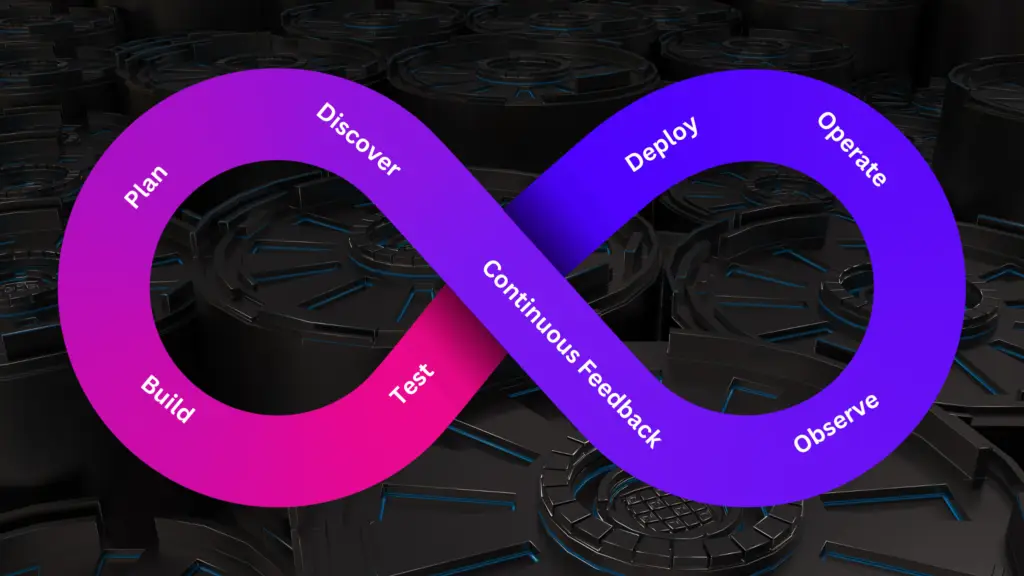
Due to the continuous nature of DevOps, practitioners use the infinity loop to illustrate the interconnection of the DevOps lifecycle phases. While these phases may appear sequential, the loop signifies the necessity for ongoing collaboration and iterative improvement throughout the entire lifecycle.
The DevOps lifecycle comprises eight phases, representing the processes, capabilities, and tools required for development (on the left side of the loop) and operations (on the right side of the loop). During each phase, teams work together and communicate to maintain alignment, velocity, and quality.
The DevOps strategy supports innovative thinking, speed, and adaptability to produce, verify, utilize, and develop software applications. To innovate goods, services, and operations, encourages a spirit of innovation, review, and continuous improvement. To adopt DevOps, though, a thorough grasp of the various stages of the DevSecOps lifecycle is required.
Phases of Devops lifecycle
DevOps is a methodology that aims to optimize the process of software development and operation. It is an approach that helps organizations produce software products and services faster while meeting customer expectations.
Everything in DevOps is ongoing, from strategy to maintenance, as we mentioned previously. Now, let’s split out the entire lifespan into seven stages, using stability as the focus. Every DevOps life cycle phase can repeat several times across the program until it is completed. The goal is to create an environment where code can move quickly through the pipeline while maintaining high-quality levels.
1. Continuous improvement
This phase is critical in defining the overall strategy for the software development life cycle. During this stage, we focus mostly on program design and address program objectives with all partners. We also manage the item backlog for continual software design, depending on customer response, and break it down into shorter versions and goals.. Once the team has agreed on the company requirements, the production team begins programming for the desired criteria. It’s a continual process where programmers start coding based on the requirements and iterate anytime if there are any areas for improvement.
Program management group facilitates production group with DevOps lifecycle tools . However, there are no tools for planning. Version management tools include Git, TFS, Confluence, and Subversion. In addition, several businesses choose agile cooperation methods such as Scrum, Lean, and Kanban. Amongst all these tools, teams widely utilize GIT and Jira for complex tasks and effective team interaction during development.
2. Continuous integration
The most important phase of DevOps lifecycle is ongoing integration. In this phase, we release and merge upgraded programming, add-on functionality, and additions into the current code. We identify errors in the program and remediate them during the testing phase, updating the source code accordingly. This stage transforms integration into a continual process in which we evaluate code after each commit cycle.
Teams use Jenkins, GitLab CI, and CircleCI among some of the DevOps tools to enhance the program process more efficiently. Jenkin, for instance, is a popular open-source application for automating builds and testing. But on the other side, CircleCI and Buddy are business products. So, whichever continuous integration solutions you choose, make sure they are compatible with your company’s and project’s needs.
3. Ongoing Testing
Quality testers use docker instances to test the software for bugs, anomalies and issues during this step. If a bug or error occurs, the team returns the program to the integration phase to address and fix the issue. Automation screening also reduces the overall run time to produce high-quality findings. Teams employ tools like Selenium during this phase. Furthermore, test automation improves the test assessment report and lowers the expense of delivering and maintaining the testing environment.
JUnit, Selenium, TestNG, and TestSigma are some of the DevOps tools used for continuous monitoring. Among them, Selenium stands out as the most widely used open-source automated testing software, providing compatibility with various platforms and devices. But on the other side, TestSigma is a comprehensive AI-driven testing automation system that uses artificial intelligence to reduce the technical intricacies of test automation.
4. Continuous deployment
During this stage, we release the completed program to operational servers, which is critical to the success of the overall solution during the DevOps lifecycle. Continuous deployment includes configuration control to ensure that machines release programming accurately and smoothly.
The production groups distribute the code to computers and plan server upgrades, ensuring that the settings remain constant across the production phase. Containerization solutions also aid distribution by ensuring uniformity between development, testing, operational, and staging systems. In addition, this method enabled the generation of new functionalities constantly.
The team utilizes setup administration tools Ansible and Chef to ensure the deployment workflow is seamless and consistent throughout the production process.
5. Feedback Regularly
To study and improve the program code, the team generates continuous feedback. During this phase, they analyze user behavior for each release to refine future updates and deployments. Companies gather feedback through both controlled and uncontrolled methods. The team uses surveys and quizzes to obtain structured feedback and also collects input informally via social media platforms. This phase is crucial for facilitating continuous delivery, allowing for the introduction of an enhanced version of the program.
6. Continuous Monitoring
During this stage, the team regularly monitors the application’s performance and features to detect network issues such as low RAM or an unreachable host. This process helps the IT staff quickly identify and diagnose application execution problems and their root causes. If the team finds a significant issue, they cycle the app back through the DevOps lifecycle to find a solution. Additionally, they can identify and address security vulnerabilities immediately at this stage.
7. Operational continuity
The DevOps lifecycle’s final step is critical for reducing scheduled downtime. To perform the modifications, programmers usually have to take the system down, which raises downtime and may result in a business impacts for the organization. In the end, continuous operation simplifies the procedure of starting and updating the application. In addition, this eliminates interruption by utilizing unit management solutions such as Kubernetes & Docker.
Container management solutions like docker & kubernetes make the process of developing, testing, and deploying an app across various environments much easier. The main goal of this stage is to increase the app’s uptime so that services can continue uninterrupted. Maintaining continuous processes saves designers a lot of effort, which they can leverage to reduce the app’s time-to-market.
Conclusion
Almost every organization these days is implementing DevOps lifecycle to optimize the entire software development process. The main focus of DevOps is the collaboration between the developers and the operations team. Conceptualizing a software product and deploying it in the market requires a lot of time and effort, but DevOps makes the entire journey seamless..